


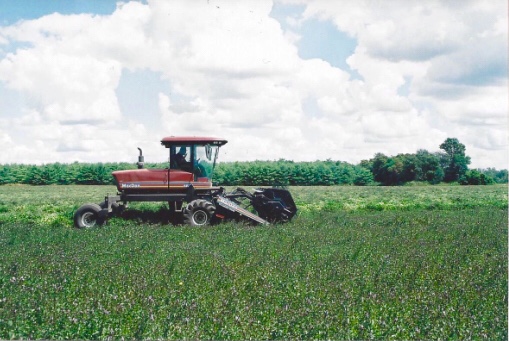
Besides farming corn and soybeans in Jasper County, Indiana, Gregg Kanne set off to try a different crop in 1994. Mint farming wasn't too common in the area. His wife, Sue's family was farming mint, and Gregg saw a great opportunity for his family. Gregg and Sue have farmed for 40 years, raised four children, and now lives on the farm that has been in his family for over 100 years.
I sat down with Gregg at his kitchen table, in the same house he grew up in, and many other family members before him grew up on the same homestead. Much has changed with the farm, but many things have stayed the same.
Harvest has slowed down, but field work continues for mint farmers, weather cooperating. Mint can either be peppermint or spearmint. Peppermint is grown on the Kanne ground.
Mint plant spreads through the roots not seeds. The mint plant can last four years in a field. The first year it is considered row mint, years 2-4 are considered meadow fields because the plants spread out with runners. After the 4th year, the field is put back into a corn/soybean rotation.
Northern Indiana soils are good for mint production. Mint grows well in well-drained soils such as sandy soils, loamy soils, and muck grounds. Mint is grown for the oil in the leaves. Oil is stored in glands on the underside of the leaves.
One acre of mint produces 5-6 Ton of mint hay, which yields 60-70 pounds of oil. According to USDA, Indiana has 11,500 acres in Peppermint production, producing 575,000 pounds of mint oil in 2016.
Mint usually is contracted three years out. The growers know how many acres they need to keep in rotation well in advance. The buying companies pick up the mint from the farm by 55-gallon barrels. It is very important to sample and grade all oil, especially since it is used in food-grade.
Peppermint oil is a very strong and distinct fragrance. The main end users are Colgate and Wrigley, farmers know their mint crop is going towards toothpaste, gum, and other flavored products.


This post was sponsored by The Glass Barn, brought to you by the Indiana Soybean Farmers. As always all thoughts and opinions are my own.

 |
| Photo Credit: Kanne Farms |
 |
| Photo Credit: Kanne Farms |
Harvest has slowed down, but field work continues for mint farmers, weather cooperating. Mint can either be peppermint or spearmint. Peppermint is grown on the Kanne ground.
Mint plant spreads through the roots not seeds. The mint plant can last four years in a field. The first year it is considered row mint, years 2-4 are considered meadow fields because the plants spread out with runners. After the 4th year, the field is put back into a corn/soybean rotation.
Northern Indiana soils are good for mint production. Mint grows well in well-drained soils such as sandy soils, loamy soils, and muck grounds. Mint is grown for the oil in the leaves. Oil is stored in glands on the underside of the leaves.
 |
| Photo Credit: Kanne Farms |
 |
| Photo Credit: Kanne Farms |
When it is time to harvest the mint, mid July through August, it has to be mowed first. It will be placed into wind rows in the field to dry. When it is time to chop the mint, it is chopped into smaller pieces, and blown into the mint tub. The mint tubs are then transferred to the distillery by a tractor. The distillery is located on the Kanne Farm.
The tubs are hooked up to the distillery. The oil and vapors from the mint pass into the condensers with 15 pounds of pressure. Oil is drained into the barrels.
After the mint is cooked, the tubs are taken back to the fields and piled in plummies. During the fall, the mint fields are plowed 7 to 8 inches deep, the roots are dormant, and it helps with overwintering, disease and insect control. The plummie piles are then spread over the fields for protection over the winter months and leftover nutrients are added back to the field.
 |
| Photo Credit: Kanne Farms |
Mint usually is contracted three years out. The growers know how many acres they need to keep in rotation well in advance. The buying companies pick up the mint from the farm by 55-gallon barrels. It is very important to sample and grade all oil, especially since it is used in food-grade.
Peppermint oil is a very strong and distinct fragrance. The main end users are Colgate and Wrigley, farmers know their mint crop is going towards toothpaste, gum, and other flavored products.
This post was sponsored by The Glass Barn, brought to you by the Indiana Soybean Farmers. As always all thoughts and opinions are my own.


